Headed south, circle completed
On March 25th, Wednesday morning. I went for a walk from our little beach side cottage up through the village along the road back toward the point. In the dark I could see the lights of the fishing boats going out into the bay. Just as the sun was first beginning to make its light visible I got to the end of the point by Fleur’s restaurant and the beginning of the Millennium Trail.
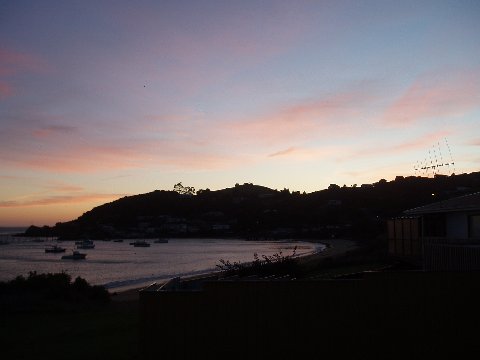
(the sun comes up over Moreraki Point)
This is a walk way which goes around the edge of the point beyond the village. The path winds along the edge of the cliff at the bottom and continues climbing in a series of switchback paths and steps to the top.
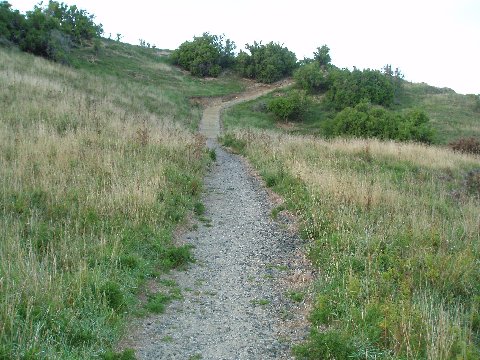
(the steps keep going up and up)
I took some detours out on to points of land that jutted out in the bay. I was standing on one of those perhaps about 300 feet above the ocean as the first red rim of the sun peaked above the Pacific.
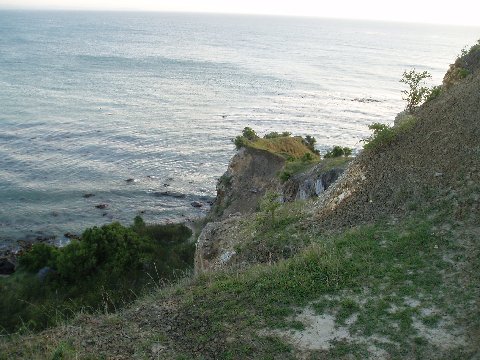
(I was standing out on this point when the sun came up)
From that point it seemed to rise rather quickly as light filled the sky and it illuminated my path. I climbed on to the top encountering several sheep on the way who seemed mildly curious about my presence. As I got near one group of three they seemed suddenly to just step off the edge into space but in fact they had just gone over a ledge onto a slope that was at least 60 degrees or more. It seemed not to phase them in the least. Finally I got to the top and the Whaler’s Memorial, the monument which commemorates the ancient sailors who stood up here, spyglass at the ready, waiting for the telltale spout of a whale in the distance. From this highest point one can see an arc of about 300 degrees of ocean and all of the village of Moreaki. Since I don’t think the ancient ones had cell phones, I hope they had some communication system to get the word back to the village, By the time they walked back down the hill, the whale would have been in Samoa.
I made my way back down the hill and circled Fleur’s with the camera taking pictures of where we had been the night before. Back at the cabin we packed up our things and backtracked to Moreraki point, the only place where breakfast was available for miles. We were eating there as yet more tour buses pulled in to disgorge their hordes of camera-toting tourists, each looking for the nearest bathroom. I much prefer our way of travel.
From there we headed south again on route 1 going in and out of Pacific views. From Moreraki down to Palmerston where we left route 1 to head into the mountains, the road skirts along the edge of the pacific with again no development visible to the naked eye. It really is like stepping back in time.
At Palmerston we got fuel and headed up into the mountains going northwest into central Otago. We followed ridge lines through the soft brown hills, actually mountains, on sweeping curves that would come around the edge of one hill and open up into a huge valley below with such dramatic change that it’s disorienting for a moment. There are mostly sheep farms here though quite a few cattle as well. The streams in the valley floors are wide and flat with crushed rock sides, again the handiwork of some ancient glacier. The changes in color were subtle but impressive. The browns and greens shaded into each other and just when one got used to the pattern, another curve would reveal something quite different in a rock formation or another valley. We stopped at a little town of Middlemarch which is what passes for a hub in this area. I’m guessing that the town may have had a population around 500. The central Otago rails to trail system is located here and we could see some of the converted railroad track down in the valley. We met some bicyclists as we stopped to look around for a café and they told us there wasn’t one (we found out later that they just hadn’t gone far enough in to town yet) so we went in to the little general store/deli on the corner. The young man running the place was from Seattle, having married a New Zealand girl who didn’t want to live anywhere else. He had a BMW R-80 back in the states and was very interested in the V-Strom as an alternative. I told him I had no complaints about the bike, but he was concerned, being used to Bavarian boxer simplicity, that the valve adjustment ritual would be too difficult. I suggested that a modern bike like this should be treated like a car, just taken to the dealer once a year for service, then forgotten about (except for the chain of course!) until the next time. Even though this was only a small grocery, nonetheless he had quite adequate sandwiches available and desserts that still further added to my waistline.
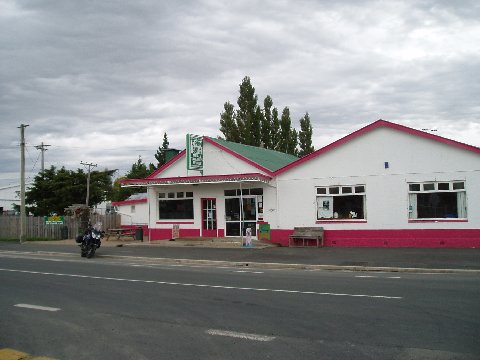
(the general store & deli in Middlemarch)
On the way out of town we find that there was another café just a few blocks down the road, but by now even I couldn’t eat any more. Shortly after leaving town, the terrain changed dramatically again. We were still in relatively low hills but now they were covered in limestone type rock. There were tall stacks of flattened limestone rock looking like the desert formations in the western USA and the fields around them just covered in hummocks of rock. The trials rider in me wanted to go play on them but the sheep probably wouldn’t have been amused. Eventually we came down from this high country back toward the coastal plain. We wanted to avoid the large city so we took a side road that promised to take us to Berwick. This turned out to be a narrow barely paved path which when it reached what should have been Berwick, turned to gravel. Normally gravel roads aren’t any big deal here in New Zealand, we’ve been on several, but this one apparently had just received a fresh coat and the gravel was perhaps 6 inches thick. That combined with a relatively pronounced slope made travel two-up on a heavily laden motorcycle somewhat exciting. Brenda was not happy. We turned around and went back to where Berwick should have been and for the second time in this trip pulled out the GPS we had brought with us. It confirmed that the “Berwick to Henley road” was the small again barely paved track to our left which would take us away from this gravel and toward route 1 headed to the southern area known as the Catlins.
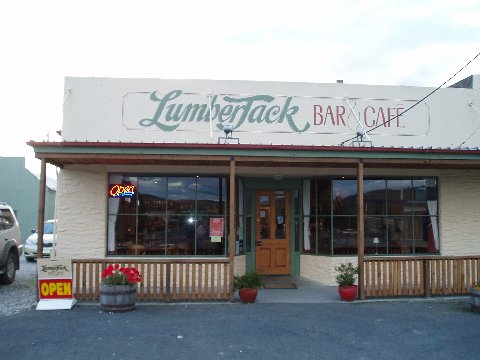
We rejoined Route 1 not far from where we had picked it up in the beginning three weeks ago. We had now completed the circle of the island by going over the same territory headed south toward Milton. This road is gently curved as it crosses the foothills which separate its path from the ocean only a few miles to the east. We could smell the salt air and see the gap behind the mountains that indicated there was nothing there but a broad expanse of water. Just south of Milton we went through the town of Balcultha where we diverted south to the southern scenic route described in our brochure. This was to take us through the Catlins which is a coastal route we thought would follow the water. It turns out not to be quite that scenic. The ocean is several miles away and apparently the small towns are to be reached mainly by gravel roads which Brenda was in no mood to try at this point.. We stopped in the night at Owaka, a town of 300 people which contains several small motels and two full time restaurants. We ate dinner at “The Lumberjack”.
There is a bar at one end made of polished wood with two sets of draft beer taps. On the right is a large stone fireplace with a roaring fire. There are few chairs setting near the fireplace and in these sit customers with glasses of wine. The menu looked like something from a fine restaurant in a big city. We made our selection and ordered a bottle of wine to go with our meal. The food came wonderfully prepared, perfectly seasoned and with pleasing presentation. Such a meal would be proudly served in any of the really nice restaurants in Lexington or Louisville, though this town by population wouldn’t even qualify as a neighborhood in one of those cities.
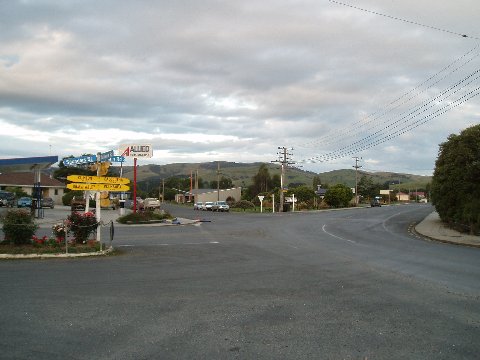
(Main street, center of town, Owaka.)
More random thoughts. Every small town we’ve been in has thriving businesses, locally owned and operated, staffed by workers who are, by American shop-clerk standards, overly friendly and helpful. It occurred to me that one way this is possible is that these local businesses have no health care costs. The local people don’t have to leave the small town and the local shop to go to a bigger city or a chain-store/restaurant company to get health care insurance for themselves and their families. They can stay in their own town. Minimum wage is higher here as well, something around $12 NZ per hour. (As a comparison, the price of an entree in one of these restaurants is about two to two and a half times an hour’s minimum wage. In the US, a similar meal in, for example, a TGI Fridays or Rafferty’s would be about 3 or possibly 4 times an hour’s minimum wage, and it wouldn’t be nearly as good.) With people being able to live and work in the same small town, the towns have a much better-cared-for look. As I write this, I’m in a town of about 300 population that also has two excellent restaurants, a library, a community center and a town swimming pool & park.
Lower East Coast NZ
It’s Monday, March 23rd. With Christchurch’s density and the coastal plain behind us, we found our way to Oamaru down Route one, still on the coast. Oamaru is an old city in New Zealand having been established in the early 1800’s. The city fathers must have had a vision of its future because they made the streets very wide, so wide even now with automobiles and truck traffic they are more then sufficient. The buildings are grander then in any other city we have seen here on the island. They are formed of large blocks of native limestone which came from the quarry where the penguin colony lives that we will visit tonight.. Since we were looking for lodging near the colony, we got a room at the King’s Gate Brydone Hotel, a very old hotel which had formally been the “Queen’s Hotel” since the late 1800’s. It is very nicely kept but still an old hotel. The rooms are small, obviously built without “facilities” which were then added in later when such amenities became popular. There is a formal dining room downstairs where one can imagine great doings having taken place in this town’s history. Our room is on the “first floor” (second floor in American-speak, with what we call the first floor being “ground floor” here) but our window looks out over the parking area where the bike is moored for the night . We can see the coast line from here and I can picture the visitors from a bygone time looking out these windows at the masts of sailing ships coming and going along the wharf. We went for a walk down through the old commercial buildings which once were warehouses and processing points for the various cargos but now are restaurants, pubs and specialty shops. Still, it doesn’t have a slick tourist-fleecing feel, but more like a town center with hubs where people gather. There are as many locals as tourists. One of the locals strikes up a conversation with us in the pub where we’re eating our fish & chips. Turns out, as is so often the case here, he’s a rider too and wants to talk about his bike, a Guzzi (they do seem to be popular here !) and his travels.
We have just come back from watching the blue penguin colony return to the nesting area from their day at sea at Oamaru. There is a viewing area set up at the end of a gravel road, in the abandoned quarry where penguins have been coming for perhaps two million years, interrupted only briefly by human activity. The area is lit at night with an orange wavelength light that the penguins cannot perceive, so that we can see them but they are in the “dark”. There are no photographs permitted, to avoid the possibility of unwanted flashes that will upset the return migration. The birds start to arrive back at the colony a short time after nightfall, about 8pm this time of year, and make their laborious way up the rocky bank. They stop periodically to spread their flippers and shed body heat that they’ve built up in their day (or days…or sometimes weeks) of swimming. They are tiny things, no more than about 18 inches high, I’d guess, but they can swim as much as 75 kilometers (about 46 miles) in a day’s feeding session. But from far out their in the ocean, their instinct leads them back to this small bank of rocks. Eventually they reach the level area that is to us a narrow gravel road, but to them a “no man’s land” they must cross to reach the protected nest boxes set up in a field of grassy hummocks. They stop at the edge of the road, look both ways several times, then in a group waddle quickly across, getting up surprising speed for such an awkward gait on land. Once in the nesting area, they split up like commandos taking up positions in hostile territory, making their way to the boxes. Then, after about a half hour or so, you can see some of them emerging from boxes, waddling across the grass and ducking into another box. Blue Penguins do mate for life, but one can almost picture in this scenario Mr. Penguin telling Mrs. Penguin he has to pop out for a pack of haddock and he’ll be back in about an hour (Or maybe it’s the other way around…I’m not real sure I can tell one gender from another, but I’ll bet they can, even in the dark.)
After most of tonight’s crew had arrived (one can never be sure how many will arrive on any given night, since when there are no chicks, the adults can stay out at sea for long periods) there is a quiet period and then begins a strange trilling back and forth from one box to another, which is either reporting in for the night, a beacon to help guide in the stragglers or the Penguin version of “Good night John-Boy”. Whatever it is, it’s eery. Brenda, who has better ears than I do, says she could hear “clicks” from the ones coming ashore that seemed to respond to the trilling from the nest boxes, apparently like a homing call or encouragement to help the group get back together on shore.
It is March 24th Tuesday. We left Oamaru at about 10:00 am after a nice breakfast at The Bridge Café. I tried “lolly cake” as an addition to my cereal breakfast. It is a signature dessert here in New Zealand composed of a dense, sweet moist cake containing slices of meringue like candy which comes in the form of “Eskimos” which the cook inserts in the batter. When sliced the candies make a colorful set of splotches in the cake. It’s quite tasty, but I really don’t need to start liking yet another sweet goody down here. I’ve already let out the velcro straps on my jacket as far as they’ll go.
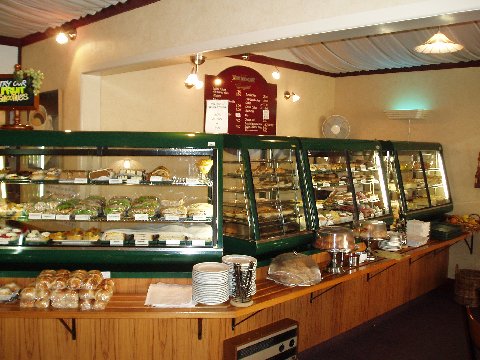
(Just another typical NZ cafe with good things to eat....the reason why my riding clothes are shrinking fast)
On the road we headed south on Route 1 for the Moreraki boulders only a few miles, maybe 20 or so, south. These are a natural phenomenon, which look like enormous bowling balls on the beach. They are perfectly spherical and some are much as six or more feet in diameter. The rock flow on the beach looks like lava rock and I came up with a theory in my head about igneous flow and surface tension forming this shape, but I was, of course, completely wrong. Apparently these Moreraki boulders are not igneous in nature but are ,according to the information brochure we picked up , concretions formed something like pearls when a particular kind of mineral begins to attract other minerals to form around it in layers which eventually build up to these huge round boulders. They form on the sea floor when conditions are right and then in this case, when the sea floor is raised by tectonic collisions (which also formed these lovely mountains) the boulders are in the resulting seaside cliffs, waiting to be exposed by erosion, then rolling down the cliff to congregate on the beach as if someone very large had left a pool game in progress.
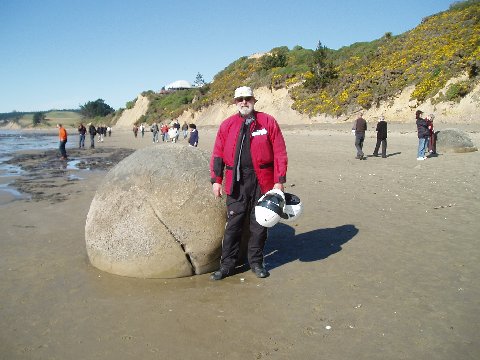
(I'm just another large round object on the beach)
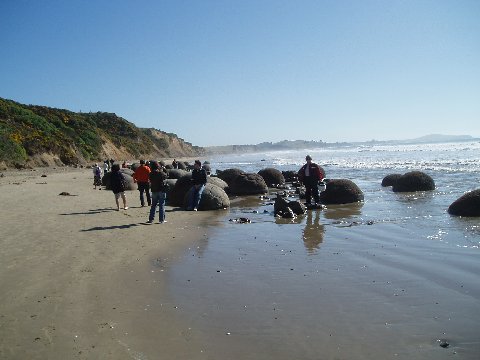
(Brenda and others waiting for the "Great Rack of Moreaki" to descend and start the billiard game anew)
After leaving there we stopped in at the town of Moreraki Point which, despite its very small size (probably less then a 1,000 people) has an internationally known restaurant called Fleur’s. This restaurant is in an old fish house sitting out on a point jutting into the Pacific and Moreraki Bay. We went there for lunch and sat out on the balcony overlooking the ocean. Our meal was fantastic. I had groper, a local fish not be confused with our grouper, and Brenda had seafood chowder with two kinds of homemade bread. I also had a chocolate torte for dessert simply because I didn’t want the meal to end. Brenda had a glass of wine but since I was riding the bike I did not partake. We sat there quite awhile in the warm sun looking out over the Pacific in this beautiful spot and decided that we really didn’t need to be going anywhere all that quickly.
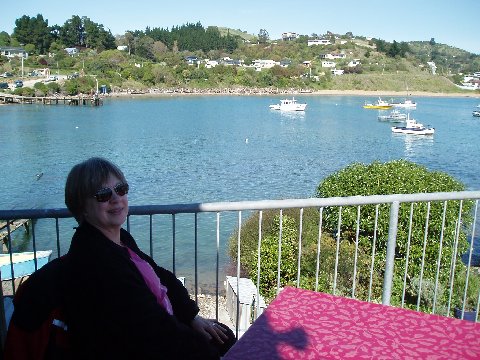
(On the balcony at Fleur's)
We left Fleur’s and went down the road and found the Moreraki Motel with a vacancy. This is not a motel in a conventional sense but instead a collection of small buildings which have been converted into rooms for rent for a day or longer. What we ended up with was a small “holiday cabin” or closer to what they would call a “Bach” here. It is a small cabin with a kitchen, living room area and two small bedrooms. It looks like it has been constructed piecemeal with no particular planning. However it has two large windows in the front which look out over the Pacific, a view that one would pay a small fortune to have in the states. Here the price for this is $95 NZ, about $56 US at that day’s exchange rate.
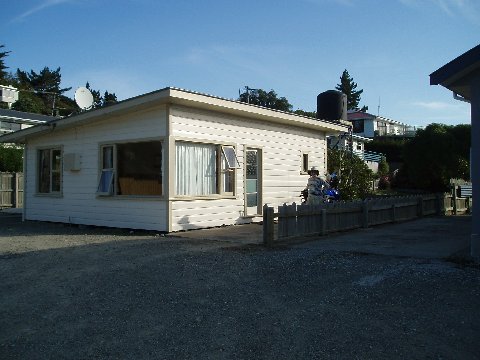
(What you get for $56 in NZ. With little effort, Brenda could have thrown a rock in the Pacific from there....had she been so inclined)
With lodging secured we took off an exploration walk. We went down the heritage trail, a path that has been made alongside the ocean leading back toward the Moreraki boulders. The beach here is mainly rocks rather than sand (come back in five million years or so and it will be sand, so I guess it’s a “starter beach”). The path climbs up and down the cliffs, in and out of secluded tree-lined tunnel-like walks, but from most of it you can still see the bay. Brenda thinks that she saw a penguin diving for fish and coming up to breathe. Again, we were the only people out there that day. And, as is the usual situation here in NZ, no litter marred the trail.
Later that evening we walked back to Fleur’s for supper. The rather rustic old building was packed for the evening meal but we had made reservations for our same balcony area. We sat out there while the sun went down over the mountains behind the beach and the air grew colder. Even though it finally got down to probably in the 50’s we were determined to stay outside as long as possible. Brenda had the scallops and I had white fish fillets with whitestone rarebit and the carrot soup. It was all excellent. We managed to finish off a bottle of wine, since we were walking back to our lodging rather than riding the bike.
While having dessert inside (we finally couldn’t take the cold any longer) we ended up in conversation with Fleur herself who informed us that her friend had just gone to Kentucky to learn more about Bluegrass music. We got her to autograph one of her cookbooks for our daughter in-law Rhonda and she took my pen to remember us by.
We walked back to our lodging by moonlight along the narrow winding road that skirts the edge of the bay. A person could get to like this sort of thing, if he worked at it.
East Coast & South
I was surprised when we left Saturday morning and made our way through Blenheim to see our only McDonalds on this trip. The absence of the golden arches everywhere else probably helps to explain the availability of such fine little restaurants in small towns. We didn’t stop.
The road from Blenheim makes a turn south and is in the hills away from the coast for awhile. These are brown hills, higher than what we call mountains in Eastern Kentucky but still only “hills” compared to the real mountains farther south. The weather, as is all too often the case with us, had turned bad. We went in and out of showers and the ever present strong wind off of the Pacific. At about Wahranui the road came out of the hills and began following closely along the coast line. I was astounded to see mile after mile after mile of undeveloped Pacific Ocean coast line bordered only by this road and a railroad track. There were no condos, no high rise hotels, no theme parks and no billboards. Nothing but seemingly endless black sand and rock beaches with the Pacific Ocean lapping up on to the rocks. Once in a great while there would be a farm house, a modest board structure whose back window would open out onto what in California would be a multimillion dollar view. Here that view is enjoyed by a farm family and a variety of livestock presumably at a far lower cost.
After many miles of such vista, we came to “The Store” a log and wood structure with a café over looking the beach. We stopped for lunch and, in what sounds now like a broken record, found a wonderful variety of excellent dishes well prepared and served by eager staff. The place was crowded by New Zealand standards in that there were at least five or six other people besides us. We took a table out on the balcony over looking the ocean and when I got up to go over and talk with some other people, a seagull tried to make off with my food.
Later I walked down the wooden steps to the beach, crossed the broad expanse of the grass covered plain to get to the rocky shore where I walked out and stuck my fingers in the Pacific. I was the only one on the beach.
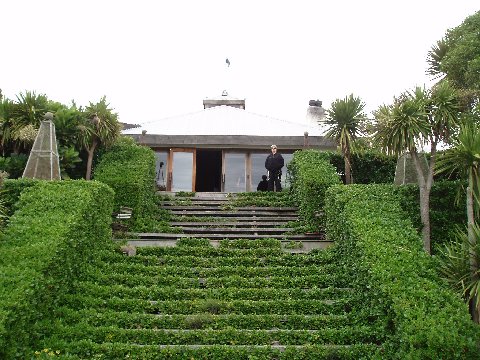
(Brenda looking down the steps at "The Store" leading down to the beach)
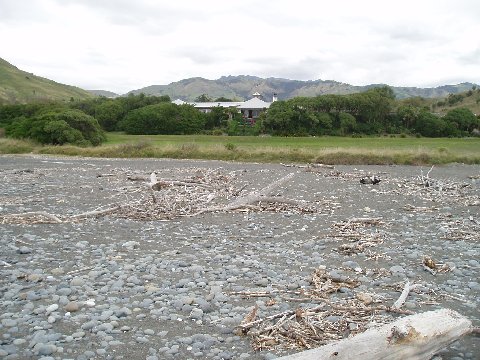
(The Store, as seen from the water's edge. See all the crowds on the beach?)
Our destination this particular day was Kiakoura where whales are to be seen most of the year. As noted in an earlier post, we had decided to take the helicopter flight in search of the leviathan. We stopped in Kiakoura just after lunch but the weather had closed in to the point that neither the helicopters nor the whale-watching boats were going out. We made arrangements to take a flight the next morning then went to find lodging for the evening. We ended up at a sea side motel in rather Spartan conditions but comfortable enough. We walked the mile and a half back into town to explore a bit. Kiakoura like many of these adventure destinations was full of young people with back packs. We got some pastry and coffee and sat at a sidewalk table for a while people watching. I decided that the variety of pastries available at this particular bakery was such that I would be forced to have another just in the interest of research. I doubt seriously if I would have any clothes that fit when I get back to the States.
That night we walked back to our hotel dropped our various items we had picked up in town and walked back to a nearby restaurant which had been in place since 1873. A photograph on the wall, taken back in the late 1800’s showed it looking much like it does now. There we had excellent meals, fish for me and salad for Brenda along with a bottle of wine from a nearby winery. We had only to walk a couple of blocks back to our hotel. This restaurant is across the street from the Pacific Ocean beach, with a view unimpeded by any development. Our table overlooked the sidewalk straight out to the beach. The meal was of a quality to be expected in a “black tie” restaurant in the states. Yet with the dollar to dollar exchange rate, we spent something closer the range of say Ramsey’s, maybe Cheddars, but with the wine thrown in for free. I really like New Zealand..
The next morning, Sunday, the weather wasn’t looking a whole lot better but had cleared off a bit. We made our way to the helicopter pad at 9:00 where we were informed that the whales were not in a predictable pattern these days. They had been acting “strangely” moving in different patterns than the whale watching group had seen in the years they have been tracking them. I wondered if the earthquake a few days earlier had upset the big animals’ vibration sensing organs causing them to move about in unexpected ways. The pilot told us that we could abort our trip if we wanted since they could not guarantee us a sighting. We decided to go for it anyway since it was unlikely we would be back here anytime soon and there is an absolutely zero chance of seeing a whale if you don’t go.
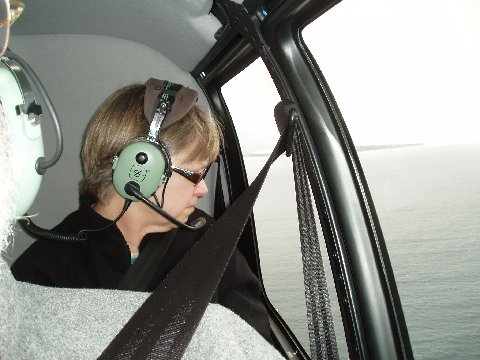
(Brenda on her second helicopter ride this trip, scanning the seas for Moby Dick)
Brenda and I had this particular helicopter to ourselves with the pilot “Scottie” a slender intense young man who did seem to have done this before. We lifted off and quickly were over the peninsula which forms Kiakoura then out into the bay and over open water. We were looking for, at 1200 feet above the surface, something roughly the size of our thumbs lying on the surface surrounded by a bit of white water and perhaps a spouting of spray when the animal breathed. Apparently they spend about 7 minutes or so on the surface breathing and absorbing oxygen so that they can go down for dives ranging from 50 minutes to more than 2 hours.
A whale, a sperm whale such as what we were looking for, is about the size of a city bus but perhaps a bit longer. In the enormity of the ocean, this is literally like looking for a needle in a haystack. We flew around for 40 minutes but never spotted a single whale. We did see a pod of about 3 or 400 dusky dolphins and another smaller pod of hector’s dolphins, the latter being apparently a very rare species to see. We had often seen dolphins from the shore and on a few occasions in Florida waters had seen them jumping out of the water not far from where we were swimming. However viewed from above (the pilot brought the helicopter down within about 500 ft of the surface) one can see how they form small groups within the pod to go after their fish meals. We also saw an albatross, a beautiful majestic bird which certainly doesn’t deserve the reputation Samuel Taylor Coleridge foisted upon them.
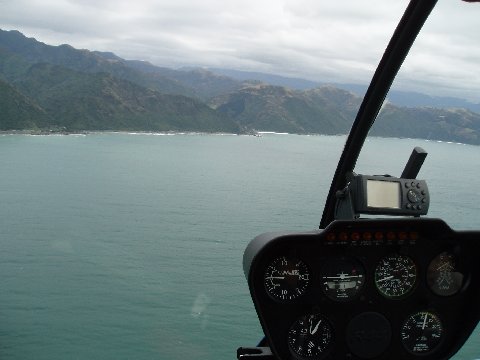
(What did we see? We saw the Sea !)
We landed back at the helicopter center and departed, only slightly disappointed because we hadn’t seen a whale. Just another case of being at the wrong place at the wrong time.
We left Kiakoura and headed south toward Oamaru. Route 1 veers quickly away from the coast as it leaves Kiakoura and winds its way through the coastal mountains. It’s somewhat odd to be on such a curvy mountain road and realize that the Pacific Ocean is less than 2 miles, away just over that range of mountains to your left. This road snakes in out of mountain passes in such a way The Dragon up in North Carolina would snuff its flames and hang its head in defeat.
Eventually though all good things must come to an end, even in New Zealand, and the road finally smooths out onto the coastal plain approaching Christchurch. The stretch of Route one that goes across the Canterbury Plain, including the city of Christchurch (from about Amberly to Ealing) is approximately 75 miles of straight flat road with at least part of a big city thrown in for a bit of confusion. We did find on that stretch, however, a decent motorcycle shop (I needed to stop to get a new tire gauge) where I met a young man, in perhaps his late 30’s, who further strengthened my good opinion of NZ riders. He said he had started out as a younger man on larger sport bikes, 1000cc models, and as he got more experience had backed down to smaller ones for the challenge and feedback on the road. His current favorite is an older (to him, that is, still modern to me!) NSR 250 Honda racer replica. On their weekend backroad blitzes, he is usually in the front of the pack on these tight curvy roads (and as he says, “If I’m not, I just tell them, Hey, it’s only a 250 !”) I was pleased to see that the “It’s more fun to ride a slow bike fast than a fast bike slow” mentality has taken root here in the southern hemisphere. He also showed us a mid-70’s Yamaha TY-80, the miniature trials bike, that the owner of the shop had restored. My son had one of these in the early 80’s and I’d like to find a good example for my grandkids….but I think shipping this restored model over to the states might be just a bit more pricey than I want for something that will end up being bashed on rocks!
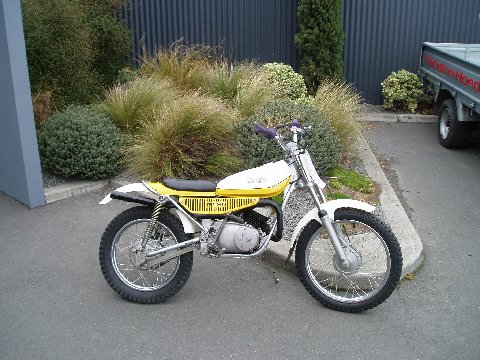
(This little Yamaha needs a home!)
As we got closer to Christchurch, it was raining fairly hard and the wind had never let up. We were passed in traffic by about a dozen large Suzuki cruisers obviously on either an organized tour or some sort of club run. As they came around us that it was clear that the stragglers in the group were terrified of being left behind and so they were willing to do anything to get around us and the other traffic to catch up to their companions further ahead. The mixture of large bikes being handled by what seemed to be relative novices in the rain and high cross winds convinced me that I should find a place to stay quickly. We ended up in Woodend at a very pleasant motel operated by a young couple who offered to let us put the bike in their garage. When the husband opened the door I discovered that my Suzuki rental bike would be sharing space with his Suzuki race bike, which sported essentially the same engine, and his Honda Race Bike. He told me that he had just sold a Motoguzzi that he just restored. See I told you this was motorcycle heaven.
The next morning we saddled up and soldiered on through Christchurch and down the wide flat plain toward Oamaru where the penguin colonies are found.