Welcome
 Welcome to the Bluegrass Beemers Blog. Something new.
End of the Ride
When I got back to town, we wandered off to find dinner. We’d sampled many of the eating establishments there so went in search of one we hadn’t tried. On a back street we found “the White House”, obviously a former residence (once called “the Anchorage” as noted by the embedded shells in the patio) now a restaurant with an eclectic menu featuring local fish, NZ dishes and Mediterranean cuisine. We sat outside in the little courtyard, by ourselves (it was getting cool and the few other diners decided to stay inside by the fire) and had excellent meals and a local wine while the sun went behind the mountains. The restaurant’s black cat came over to investigate us, then wandered back inside. I suppose if everyday life was like this, a person would get used to it and find it routine….but I’m willing to take that risk
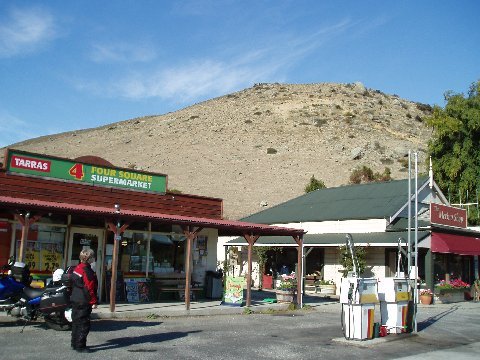
(Gas & pastry stop near Lindis Pass)
We finally had to leave Wanaka, reluctantly. We held off until the last minute, then saddled up and went into the mountains headed for the Lindis Pass and then back down to the coast. The Lindis Pass is often described in various writings as “Legendary” and it’s easy to see why. The road climbs from outside Wanaka, rising quickly along the edge of a mountain range so that one can feel the pressure increasing in the inner ear. We can see below us the road from which we came, down in the valley. Soon we’re in a high valley, much like that found in the high desert of eastern Oregon or the dry side of the Cascades.
We’re following the Lindis River through the mountains down to where it is dammed above the coastal plain. There is a brief period of swichbacks as we cross the highest part, then we descend to the town of Omarama, the jumping off point to go up to the backside of Mt. Cook. But we can’t make that diversion today, the leash is tightening, pulling us toward the sea and the end of the trip. We head down the river, ever descending, to Oamaru. As we pass the huge dam and artificial lake there is a thin ribbon of water that has been diverted from the dam to afford irrigation and water control, I assume, that follows the road like a liquid sidewalk.
The road is flatter and straighter now, following the river valley until it finally meets up with Route One and the Pacific Ocean is again in view. It’s but a short jaunt from here back in to Oamaru where we will stay for the night at “41 on Tyne” a small B&B near the Blue Penguin Colony. We’d noticed it the last time we were here, as we walked to the colony, and thought it looked interesting. The “room” there is actually a separate cottage in the steep front yard of the house which sits above it on the hillside. The driveway is quite an incline, not anyplace I’d want to leave the bike for the night, so our host Carola tells me to put the V-Strom in the yard beside the cottage, an area reached only through an opening in the trees, over a small bank. It will be quite safe there…once I get it there. It really isn’t as difficult as it looks and the bike is quite easy to handle once the bags are off, so it goes right where I want it. We’ll worry about getting it back out in the morning! We want to explore this old harbor town again to get a better feel for the limestone buildings and the old wharf area we breezed past last time.
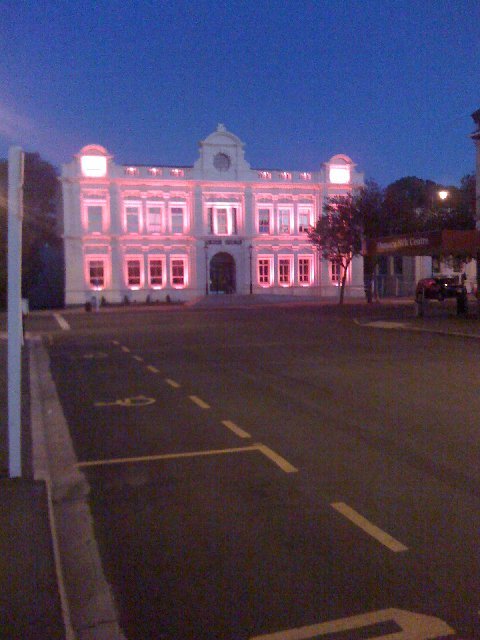
(The Opera House building in Oamaru)
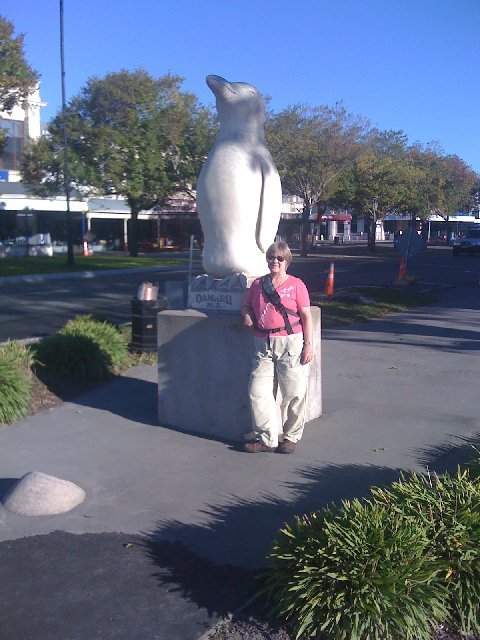
(Brenda & friend in Oamaru)
We walked for about an hour and a half through the streets of Oamaru, including a several block diversion to visit the historical home of native author Janet Frame, who grew up here. Her modest house has been preserved as it probably looked in the 30’s when she lived here from age 7 to 19. We can imagine that the area around it was somewhat different then, the street most likely not paved, the housing not quite as dense in the neighborhood. The town in this part is on hills, reminding us just a bit of parts of San Francisco, but as that town must have looked in its very early days. We walk back down to the town center, crossing the wide main street toward the harbor. We have now learned that the space afforded in the street was not due to extraordinary vision of the future needs, but instead the necessity of room to turn around freight wagons, pulled by teams of 12 bullocks, as they moved cargo from the harborside to the warehouses and mercantile establishments up on the main road. Nonetheless, it certainly gives the town an expansive feel, a look like a place where big things have happened and can happen again.
By now we’re feeling a bit peckish and in need of yet another fine meal….oh, the difficulties of travel in NZ ! We had already selected the Portside Restaurant, where we were going to eat the last time we were here. It was closed then for a holiday, but we now had a second chance. The restaurant juts out into the bay overlooking the seawall and, on one side, the area of the penguins. We ate out on the deck as the sun disappeared over the city behind us. At a nearby table, a young family was eating, with the kids often disappearing down to the waterside to play. One little girl, perhaps 7 years old, came back to the table crying. When her mother asked the reason, she said, in her charming accent, that another child had told her she was “annoying”. Such a civilized epithet for children to use !
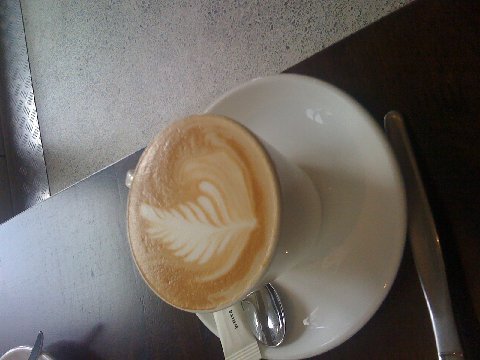
(Even a cup of coffee is art in NZ…the silver fern is their national symbol)
We walked back to our lodging, hoping to see a straying penguin, but no such luck tonight.
Our last day on the road, Monday the 30th. We awoke in Oamaru in our “self contained” B&B cottage and availed ourselves of the variety of cereals, coffee & tea there for us. Our host, Roland, arrived at our door with fresh bread he bakes for guests. He and his wife are ex-pat Brits who apparently emigrated to Australia, then on over here to NZ. He was in engineering for a while but now does part time consulting and full-time B&B. In such a nice place, not a bad situation to be in.
The Suzuki came out of its berth quite easily, as I expected, just a bit of care needed with the turn onto the sloping driveway, and I backed it down to the street to accept its burdens for the ride home. We loaded up for the last time and hit the road south, going slower now, trying to drag out the last bits as long as we could. Another stop at Moreaki Point for coffee and view (and to pet “Havoc”, the chocolate lab who belongs to the café . His name is the antithesis of his personality….if only our Malcolm could be so calm !…and he greets each visitor with solemnity, assuring each that if only they will abandon their journey to spend the day petting him, all will be well.) The boulders hadn’t moved any since our last visit.
At Waitaki, we veer off of Rt. One and head over the mountain on what is described as the “bicycle route to Dunedin” that Roland at the B&B had recommended. It turns out to be not exactly my idea of bicycling, since the inclines are steep and very, very long, but the views of the valleys below are amazing. (My friend Gary Griffin would find this to meet exactly his idea of bicycling, by the way.) When we get above Dunedin, the whole city spreads out beneath us, rimming the bay and climbing up the sides of the hills. I can’t look long, since even a short loss of attention to task could have us over the side and provide a very exciting but brief end to the trip. When we finally reach the bottom of the hill, we’re on North Street which I recall is the route to Baldwin Street, billed as the “steepest street in the world”. Anything that is the most of whatever it is “in the world” deserves to be seen, so I sought it out. If it isn’t what it claims, I can’t imagine what would be. I stopped at the bottom, marveling that there were in fact houses arranged up the sides of what had to be nearly a 45-degree slope…or more, it’s hard to tell from down here looking up. There was a single car parked at the top, facing down (I’d hate to think of backing down this hill) and I wondered just how well its owner trusted his emergency brake.
I didn’t go up the hill (partially because Brenda, being sensible, refused to go up with me if I did) because I couldn’t see what was at the top so the thought of turning around a rented bike on such an incline just didn’t seem like a good idea. From there, we headed on down into the center of Dunedin, the city traffic marking a return to the real world we’d avoided for over three weeks. We needed lunch (well, OK, didn’t really need it…I won’t need to eat for at least another month) so we diverted out to Port Chalmers, a small working port town out on the bay, for one last meal on the road. We selected a likely looking café where we ate interesting salads (by that I mean that I’m not really sure what was in them, but it was quite good) out on a little courtyard under trees and pondered the end of the line….and where we’d like to go next.
We returned the bike to the Weir’s home on Maori Hill and unloaded the bags. Howard & Judith weren’t home yet, but they’d left the door open to their loft apartment over the garage where we would stay until the next morning when our flight left for Auckland. When they did return from work (Howard’s a firefighter and Judith’s a teacher) they invited us for dinner to share fresh fish Howard had caught a day or so earlier off the coast. It was yet another grand meal (the best fish I think I’ve ever experienced) and lively conversation with a most interesting couple (them, not us) aided by a bottle of excellent local wine. The Weirs run this motorcycle hire business as an extension of their love for the sport and their marvelous country. Not quite so many riders from our country make it down to Dunedin, here on the south coast of NZ, for independent rides. The majority seem to fly into Auckland (apparently the only direct international flights into Dunedin airport are from Australia) and rent there or take organized tours from there or one of the larger cities in the North. As Howard pointed out, the best motorcycling is to be found on the south island and the population here is one-third of the north island on twice as much space. In my view, the big cities of the north would be a distraction from the ride. It makes more sense, for my kind of trip, to take the short flight from Auckland down here to Dunedin, rent a bike that seems perfect for the conditions here, and start a fantastic ride from the moment one leaves Howard & Judith’s driveway.
Tomorrow it’s back on a plane to Auckland, then a day in the big city, and head for home.
Wanaka
It’s Saturday March 28th. We woke up this morning here in Wanaka to the sight of the rising sun illuminating the peaks across the lake from our room. The mountain tops were bright golden above the green grassy slopes below. The tops are too high for anything more than low beige grasses and cold-proof vegetation to grow on.
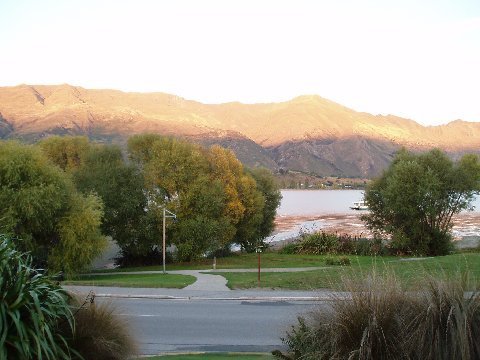
(early morning, Wanaka. The park begins across the street from our room. The trail goes either direction from here)
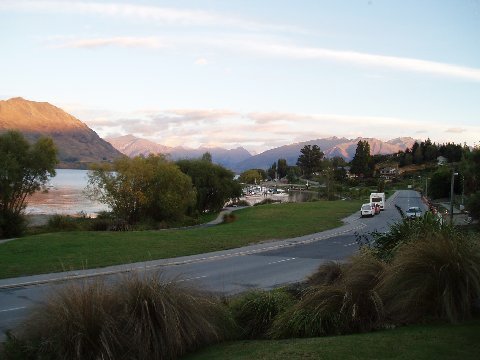
(those mountains in the background are waaaay far away!)
The lake was relatively smooth this morning and the ducks were out enjoying it. I walked the short distance across the park into town to pick up morning pastries for breakfast. The bakery were I sought something for Brenda had warm sultana scones just out of the oven. In the parking area for the small lakeside park a station wagon full of young people were just coming to life after having slept in their car the night before. A tall young woman stood beside the car, rubbing her eyes, while inside, a tangle of indistinct bodies and sleeping bags was stirring like a basket of puppies trying to wake up. Back in our room Brenda had pastry and coffee in bed while I worked on the computer handling what I could from my office, where it was just after lunch yesterday. Soon however 3 or 4 of the ducks from the lake had wandered up to our sliding glass door demanding their expected payment for being cute. We of course complied.
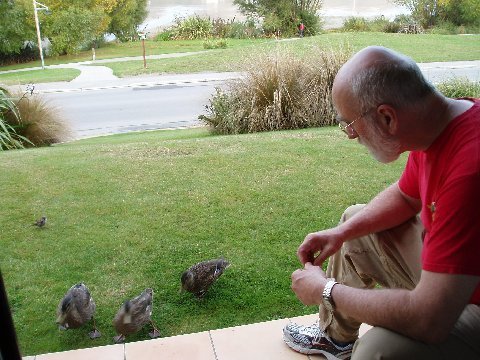
("Come across with the pastry kiddo, and nobody gets hurt, see". We've got beaks and we know how to use them")
Later in the morning we sat out for the walk on the travel path around our side of the lake. We saw a group of children preparing to take off in small sailboats, apparently being instructed by some men in the art of sailing. Like all young boys, they were more interested in testing the limits of the craft in motion, spinning around in the tightest turns possible, than in accuracy. The trail goes to a camping area called Eely Point. The views of course are indescribable in my poor vocabulary. People may find it strange when they ask what we did in a tourist area like Wanaka, when we say “we walked” but I can’t think of any better way to see this gorgeous country. It also occurs to be for most people who go on vacations to do something at a place, they spend their time traveling to get to a thing they are going to do. When we travel by motorcycle however we are doing the thing we want to do as soon as we leave the parking area. We are doing our activity all the time, not just when we arrive somewhere. We saw ads for rafting, jet boating and bungie jumping but we’ve already had our excitement just getting here. We are now content to walk these quiet forested paths with the beautiful aftermath of nature’s power in our view at all times. Storms damage a relatively wide area by human standards, but nature’s wind is temporary and limited in scope. A tornado may tear up a swath of buildings or blow down some of man’s other constructions, but a glacier rearranges mountains, creates lakes that go for miles and flattens out areas the size of major cities.
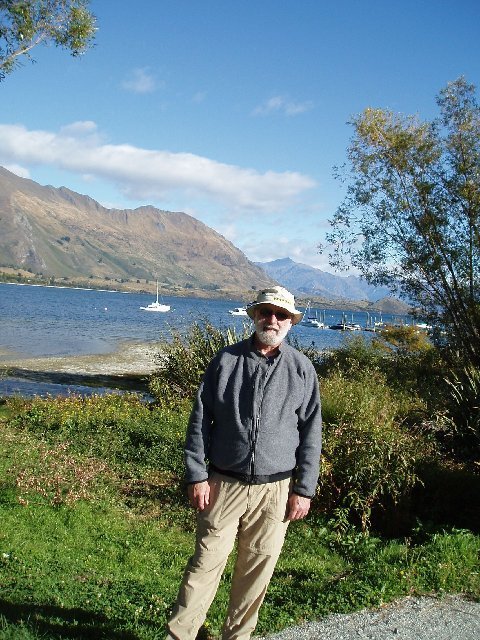
(this would be "the old man of the sea", but it's a lake and the "old man of the lake" just doesn't have the same ring to it.)
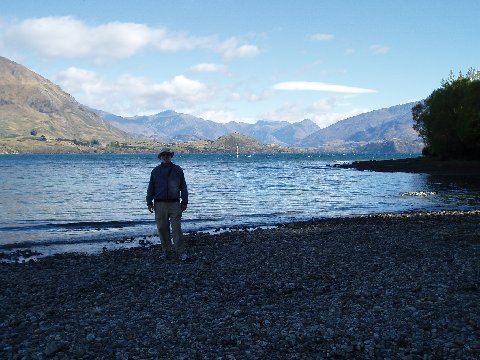
(same old man, same lake, farther along)
We stayed two days at Wanaka, a town we both loved from our first night here a couple of weeks ago. I went for a solo ride while Brenda stayed behind for some quiet time in town. I thought I’d go explore the road around the west side of the lake going toward the mountains we could see rising in the distance. This road quickly leaves the lakeside and twists off into the foothills (read “mountains” in Eastern Ky terms) rising and falling in perfectly radiused turns as if designed by a motorcyclist. Since it follows the curve of the hills, one could ponder just how sympathetic Ma Nature is to our needs after all. The mountains take a long time to seem any closer, an indication of just how doggone big they are. I finally realize that I’m not actually going to get there if I have any chance of getting back to Wanaka before suppertime and, as has been a constant feature of this trip, my stomach won out and I turned around.
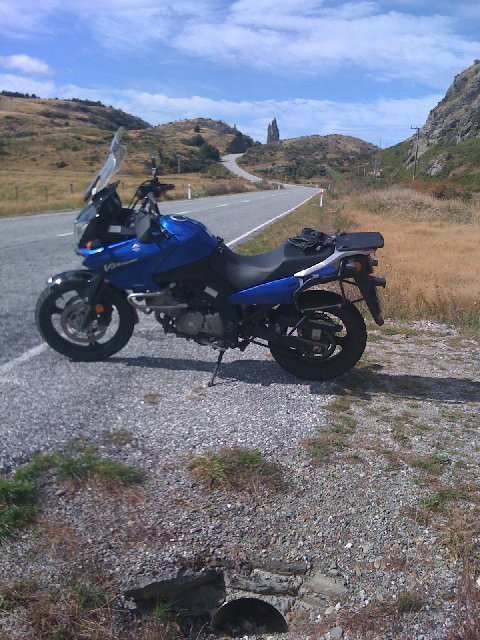
(and it goes on this way for miles and miles....)
One of the things that I have neglected to mention so far is the number of one-lane bridges in New Zealand. I guess it makes engineering sense in that you only have to build a bridge one-half as strong since it will never have two lanes of traffic on it. The system seems to work rather well when there are so few cars on the road. One comes to a set of lane markings that tell you a one lane bridge is coming up and there is a round sign with two arrows pointing in opposite directions, one larger and a different color than the other. If the larger colored arrow is pointing in your direction of travel, you have the right of way and if it’s the smaller arrow then you must yield to someone coming through the other way. Everyone seems to understand the system and it works well except when the bridge is around a blind curve and you don’t see it coming until you are already on top of it!
When one is only used to traveling by car, the view of the world framed by a windshield and hardtop becomes the “normal” one, the frame (literally) of reference for how the world in motion looks. Even in a convertible automobile with the top down, the driver is held in one spot, level to the horizon, front view still constricted by the windshield frame, side and downward view limited by the car’s bodywork. When I talk about what I see, what I experience, from a bike to someone who’s never been there, I can tell that they have no reference point for understanding what I’m trying to impart. Kurt Vonnegut once wrote in parable about the Tralfamadorian’s, an alien race whose experience of time was not like humans. In trying to explain it, he likened the human experience of time to a man seated rigidly on a railroad car with his head encased in a turret, immobile, with his view only forward, only of what visible out of the gunbarrel-like tube extending from the turret. The railroad car could only go in one direction and the man could see “time” as what unfolded through the barrel’s aperture as the car moved inexorably forward. The Tralfamadorians, in contrast, were above the plain upon which the track ran and could see everything around it, forward, backward and on all sides, at once. While a motorcycle doesn’t afford quite that degree of omniscience, it is an improvement of the same kind, if not degree, over the car experience.
Counting down the days too quickly
We gave the Catlins short shrift, I fear, after we found that the beachfront areas could only be reached by gravel roads. The paved road through the area was pretty enough, with low hills and lots of curves and quite a few places where the ocean suddenly came into view as the bike rounded a hillside. (Again, the ocean with completely undeveloped coastline.) We stopped for our mid-morning snack at the “Whistling Frog” café, part of a “holiday park” which catered to camper vans and small camping trailers which are ubiquitous here in New Zealand. We spoke to the manager of the place (and the farm which was part of the same operation) who told us that this had been their best year for quite some time. The weather had been good for farming (i.e. wet) and the tourist trade from Europe, the Orient and the US had increased dramatically. The favorable NZ dollar rate has made it a very popular destination.
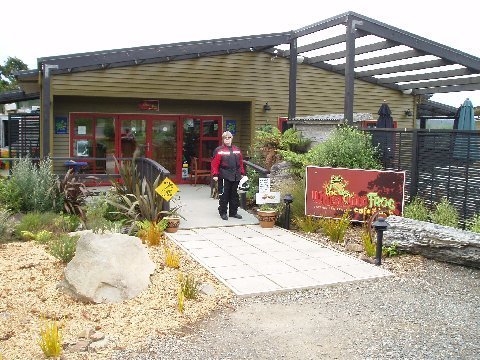
(we didn't actually hear any frogs whistling, but it is fun trying to picture how they'd look doing it)
By the time we left the café, the rain had picked up again and the ever-present wind was beginning to become bothersome at times. I missed a turn at the beachfront area of Fortrose (at least there was a road shown on the map which I never saw on the ground….it might have been gravel and unmarked ) and we ended up going on into Invercargill, where, due no doubt to an oversight on the part of the New Zealand tourism commission, there is no center-of-town monument to Burt Munro, and his garage, with its Offerings to the Gods of Speed is not one of the places marked as a “must see”. We did come into town through neighborhoods that looked just like the one in the movie portrayed as his. Lunch was at an old hotel café where we were served by a pleasant young woman who told us she was from TeAnou. When I asked her why she had left such a pretty place to come to an industrial city, she said “because I’ve lived there all my life”. She said she’d probably go back when she got older. It’s the universal human urge to go “somewhere else” and see what’s over the next horizon. As we left town, on roads I’m sure Burt traversed on his Indian, the wind and rain resumed, making travel rather slow. We had decided to go north again, to pick up in our last days here a few of the favorite places we’d visited before. Our leash was growing short, the bike has to be turned in on the 30th, so we can’t get too far out of range of Dunedin. We headed for Wanaka, but made it only as far as Roxburgh that night. As we came back into the mountains of Central Otago, both of noted that this seemed to be the area we most liked. The scenery is still mind-blowing, but not so overwhelming as the craggy mountains of the West Coast where nature isn’t quite as far along in her softening process. Here in Otago, the high hills are again covered in limestone-looking outcroppings and the valleys are deep, with the landscape at times looking like Ireland, other times the north of Yorkshire in England and others, Bavaria. It’s easy to see why peoples from all over the world have come here to settle…for an awful lot of them, it looks like home. At Roxburgh, we found a small motel off the main road, with an unusual parking arrangement. Each unit has its own “garage”, a secluded covered parking area lacking only an outer door to be fully enclosed.
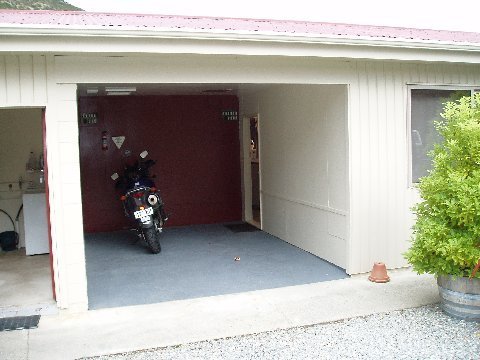
(Even for NZ, a motorcycle-friendly place if ever there was one, this is exceptional)
Inside the unit, there was a bedroom separate from a kitchen/living room, more than adequate for staying extended periods of time. And all this for about US $45. We asked the proprietor about getting a meal. He called the local hotel (here in NZ, “hotel” usually means a combination of pub and restaurant, not always or even typically with any lodging function) and gave us directions to it, just around the corner. When we got there, the publican escorted us back into the dining room which was normally closed for the evening, but opened just for us. He and his wife catered to us in our “private” dining room, with an excellent meal, local beer and wine and charged us the princely sum of about $40 US for the experience. When we expressed our gratitude for such service he replied “We do this all the time”. As I said earlier, this country is set up for people who travel.
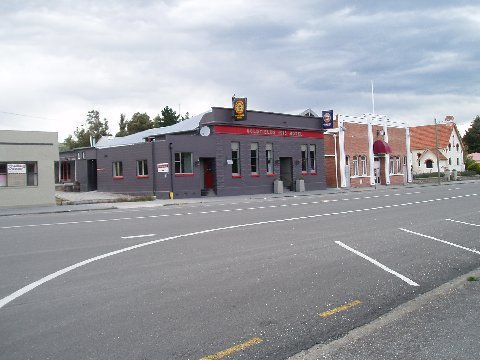
The old hotel with the marvelously personal dining service
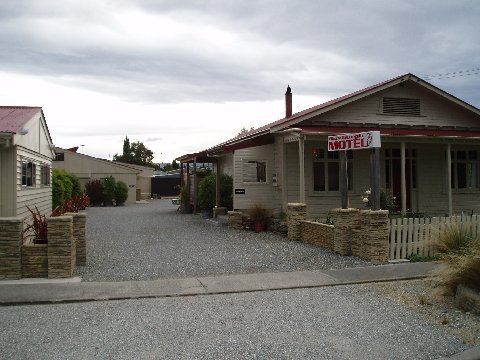
The Roxburgh Motel
The next morning we left Roxburgh headed north, feeling the pressure of time running out. It’s only a short run from there to Clyde, the small town where we’d spent our first night on the road. We wanted to have “elevenses” (a charming English custom of having a snack at 11 AM, to tide one over til lunch) at our favorite café there. We arrived just about on time, parked in front of the café and strolled over to the outside tables. An older lady sat at one with her morning paper, coffee & pastry and a Border Collie under the bench. The dog, as is typical of her breed, seemed eager but too well trained to do anything out of order. With the owner’s permission I began the pet the animal who let me know that this was exactly the right thing to do. The owner laughed and told me I’d get tired of doing it long before the dog would. She was right. We (Brenda and I, not the dog) went into the café and were greeted by the owner who recalled us from three weeks earlier. She seemed pleased to see us, as though she expected us back like locals. We sat outside on the street, enjoying our wonderful breakfast plates (these folks really understand the concept of breakfast, in my book) and just soaking up as much of the flavor of the town as we could.
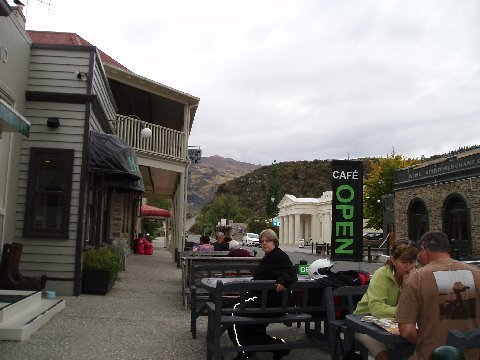
(Brenda on the sidewalk in front of the cafe in Clyde. The border collie is under the table behind her)
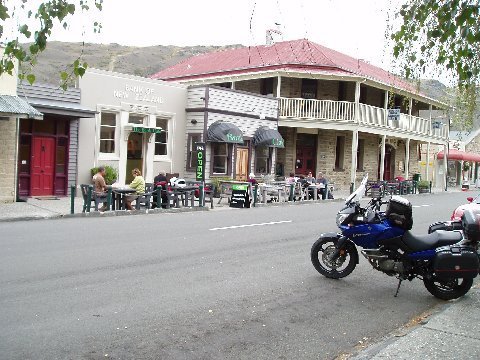
(The cafe across the street is, I think, our favorite of an overall wonderful lot in NZ)
Back on the bike, we made our way up beside Lake Dunstan toward Wanaka This road had amazed both of us three weeks earlier and it hadn’t diminished a bit. As we left Clyde, the road climbs up the side of the mountain on the east side of the lake, high above the water’s surface, then begins to drop in curves down to just above the shore, though “shoreline” isn’t exactly a good description. The side of the road, to my left (I’m in the left lane, remember) ends and then there is a dropoff of sheer rock about 50 feet down to the surface. I can’t spend a lot of time looking around. At Cromwell, the road crosses the lake and heads up the other side, now in low hills bordered by vineyards and orchards. Here the wind picks up in earnest, causing us to slow to 60 or 80 KmPH just to keep the bike on the road. The wind is a constant feature here in New Zealand and it seems to my non-native view, a somewhat unpredictable feature. It often comes from the direction you don’t expect and then sometimes can change direction 180 degrees without warning. Obviously, the farmers here pay attention to it because they erect large windbreaks that we see often from the bike. At a distance these look like an ordinary box hedge such as you would have around your suburban yard, except when you get closer you see they are 40 feet or more high and 20 feet wide, composed of evergreen trees that are planted so close together that the branches intertwine making a solid barrier. What I don’t know is how they trim them into such perfectly box- like shapes. I can’t imagine a set of hedge clippers that size. These windbreaks can be as much a half mile long beside the road or outlining a field like a fence. We often saw herds of sheep or cattle arranged along the base of these, seeking shelter. On the motorcycle the wind can be a problem. We are constantly banking into it as if going around a curve when we are on a straight stretch of road. When it strikes suddenly as when one comes through a canyon, it can almost upset one’s balance. When going into a head wind its like being battered about the head and shoulders. Going along of the sea coast one can see the wind blowing the water up on shore but the prevailing wind that you are fighting is coming from the opposite direction. I’ve come to expect it somewhat, but it always manages to surprise me. The wind died down as the road got further from the water going into Luggate and making the turn up into Wanaka.